Some media attention has been given lately to the discovery and dating of the preserved footprints of humans and extinct animals in the dry bed of an ancient lake in White Sands National Monument. The DNA of pollen associated with the prints suggests an age of twenty thousand years. That puts the arrival of humans in the New World much further back in time than previously thought. It also means that the humans were coexisting with some fearsome large predators including Saber-toothed Cats and Dire Wolves.
The Dire Wolf exhibit at the Natural History Museum is nicely lit by large nearby windows, making it an attractive subject for my cameras. On this occasion I was shooting my Olympus Pen-FT with the 1.8/38mm lens.
Showing posts with label New Mexico Museum of Natural History. Show all posts
Tuesday, July 30, 2024
Sunday, December 16, 2018
The Best of the Bunch
Left to my own devices I would likely not have acquired my Nikon FE. It was a generous gift from an online photographer friend. The design and construction of the camera are right up there with Leica in regard to quality. That becomes immediately apparent when you pick up the camera and crank the winding lever; the movement is extraordinarily smooth. And, there is a vast number of Nikon lenses available to the camera. My resolve to work more with the FE was further bolstered recently when I figured out that I could use my nice old 105mm Nikkor-P Auto f2.5 lens on the FE by just flipping up a tab on the lens mount. So, I put aside a couple other projects, loaded some TMAX 100 in the camera, and took a stroll through the neighborhood.
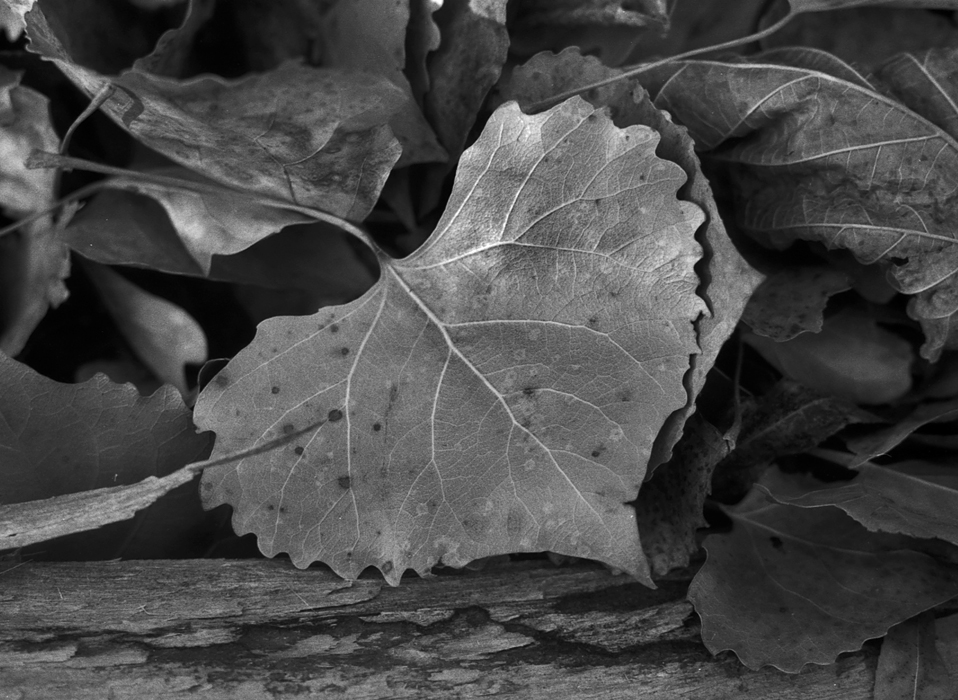
With half the roll of TMAX remaining the next day I mounted the Nikkor 1.8/50mm and took a walk beside the river. That turned out to be a less than fair trial for the camera and lens as I had Margaret's very active dog, Roxie, tethered to one arm. So, the equipment performed rather better than I did. Still, I saw a lot of nice subjects that I'll get back to again soon. The cottonwood forest is carpeted now with a dense layer of dry leaves. The river this time of year is full of migrating bird life. There were five Sandhill Cranes on a nearby sandbar when we stepped out of the trees. Two raucous ravens across the river drew my attention to a Bald Eagle perched high in a cottonwood's bare branches.
I processed this roll of TMAX in HC-110, dilution H. That formula uses half the dilution-B concentrate of developer and requires twice the time to develop. The outcome is a bit less contrast than one gets from dilution-B. It worked as expected, though better in some instances than others. I'm thinking that for the next roll of TMAX I'll try going back to dilution-B with a developing time of six minutes at 20C rather than the seven I have been using lately. The guides I always consult for this sort of thing are the HC-110 Developer Resource Page and the Massive Dev Chart.
With half the roll of TMAX remaining the next day I mounted the Nikkor 1.8/50mm and took a walk beside the river. That turned out to be a less than fair trial for the camera and lens as I had Margaret's very active dog, Roxie, tethered to one arm. So, the equipment performed rather better than I did. Still, I saw a lot of nice subjects that I'll get back to again soon. The cottonwood forest is carpeted now with a dense layer of dry leaves. The river this time of year is full of migrating bird life. There were five Sandhill Cranes on a nearby sandbar when we stepped out of the trees. Two raucous ravens across the river drew my attention to a Bald Eagle perched high in a cottonwood's bare branches.
I processed this roll of TMAX in HC-110, dilution H. That formula uses half the dilution-B concentrate of developer and requires twice the time to develop. The outcome is a bit less contrast than one gets from dilution-B. It worked as expected, though better in some instances than others. I'm thinking that for the next roll of TMAX I'll try going back to dilution-B with a developing time of six minutes at 20C rather than the seven I have been using lately. The guides I always consult for this sort of thing are the HC-110 Developer Resource Page and the Massive Dev Chart.
Wednesday, August 13, 2014
3 million years
I stopped by the Museum of Natural History this morning with my Welta Perle. The compact folder was loaded with TMAX 400 film.
The preparator was carefully grinding away the rock surrounding one of four tusks belonging to an ancient species of elephant which roamed southern New Mexico about three million years ago. Behind him on the bench is the complete skull of a stegomastadon from the same era that was recently discoverd on the beach at Elephant Butte Reservoir.
Thursday, November 01, 2012
Mesozoic New Mexico
A hundred million years ago New Mexico was tropical and wet and full of dinosaurs. Quite a lot of them have been dug up and hauled to the New Mexico Museum of Natural History just a couple of blocks from my house.
The fossilized remains arrive encased in thick plaster which is broken open at these work tables. Chipping away the rock in which the bones are embedded is a process that can take years to reveal a single specimen.
Subscribe to:
Posts (Atom)