Showing posts with label Zeiss Ikon Contaflex I. Show all posts

Monday, October 01, 2018

A Sentimental Favorite

My Contaflex I was an early acquisition and one of only two of my film cameras that I have sent away for repair.  The other was my Kiev IIa which was restored by Oleg Khalyavin.  As it turned out, the repair of the Contaflex did not work and I ended up tearing it down myself to fix the sticky aperture stop-down mechanism.  The repair was not terribly difficult, but it did take considerable research on the web to find the proper techniques for disassembly and adjustment of the leaf shutter slr.  My success with the camera likely included a good dose of luck; I think if I were to be faced with the same situation today I would likely send off the camera to someone with real expertise such as Chris Sherlock.

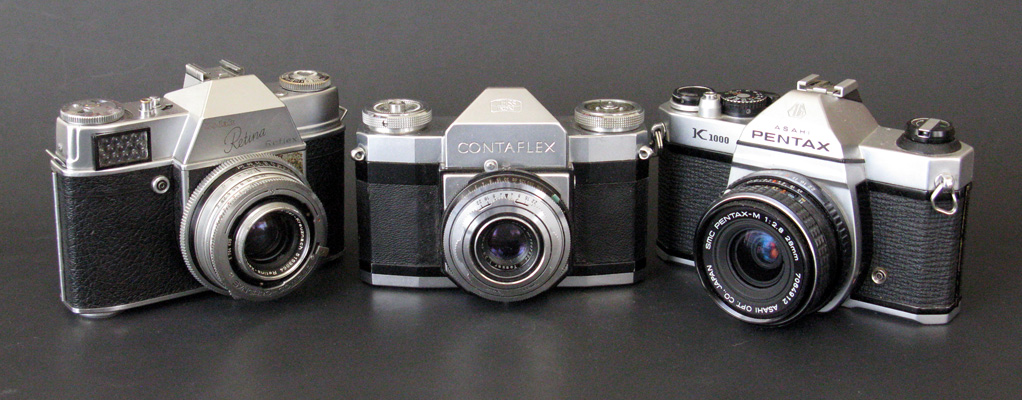
Zeiss Ikon pioneered the design of the leaf-shutter single lens reflex camera with the first Contaflex which came to the market in 1953.  The company brought some radically new thinking in camera construction to the task which seems likely to have been inspired by the work of Hubert Nerwin.  Although Nerwin was long gone to America by 1953, there are many aspects of the Contaflex design which echo his innovative thinking as it was manifested in the Contax II, the Contessa 35, and espcially in the little Ikonta 35.  As shown in the comparison below, the Contaflex was significantly smaller than the contemporary Kodak Retina Reflex or the much later focal plane shutter models like the Pentax K1000.


Aside from the appealing compactness of the Contaflex, the camera's real strength as a picture maker was the superlative f:2.8/45mm coated Tessar lens.  I had some familiarity with the lens design in earlier 35mm and medium format cameras and the prospect of actually viewing the world through a Tessar on an slr was compelling.  These many years later I don't have a camera which inspires more confidence in operation than the Contaflex. I proved that to myself again in the past week when I took the camera out on walks in the neighborhood and along the river.

Visiting the Past in the Plaza Vieja

Fairlane 500

In 1957 the Contaflex was still in production.

plastic and stucco

Proxar 0.5 accessory close-up lens

ocra at f:2.8

Roxie at the River
The Contaflex I Manual is at the Butkus site.

Sunday, July 16, 2017

The Classic Experience


I get out with my Contaflex I several times a year.  The camera always produces some nice pictures for me, but it also provides a hands-on opportunity to experience the culmination of a half-century of small camera design and production by Zeiss Ikon.  High precision craftsmanship combined with the finest available materials permitted the implementation in 1953 of a single lens reflex camera with a uniquely compact form that would not be surpassed for another decade by Japanese camera makers..


The Contaflex I did not have the interchangeable lenses and light meters of later models, but Zeiss did offer a large selection of accessories for the camera including microscope and stereo adapters, and most importantly perhaps, the add-on telephoto lens known as the Teleskop 1.7x.  The telephoto and several of the other accessories were attached to the camera in front of the fixed 45mm lens with a slide-on bracket.

The bottom 4 elements are the fixed 45mm camera lens
The Teleskop 1.7x produced the equivalent focal length of about 75mm which could be focused as close as four feet and which was likely intended primarily as a portrait lens.  As shown in the lens diagram the Teleskop 1.7x was a massive six-element design which could only be expected from Zeiss.  I think I have only once used the telephoto on my camera, and I would be hard put to find the photos now.  I'll try to remember next time I get out with the Contaflex to make a few shots that show the capabilities of the lens.

The Contaflex I can frequently be found offered on ebay in the $25 to $45 range, which seems extraordinary for such a finely made instrument.  The reason for that is that any Contaflex which has not been recently serviced is not likely to be ready to make pictures.  Nearly all of them will require cleaning of the shutter and the aperture stop-down mechanism.  This basic servicing of the camera is not really very difficult, but it is a great help to have some idea of the camera's unique construction features, including the three tiny screws holding the front lens element in place which are hidden under the distance scale of the front-focusing lens.

Here are some recently made pictures from the Contaflex I made during a walk along the Rio Grande:


Sunday, September 11, 2016

Morning Walk

Most weekends during the summer there is a small informal car show in the Plaza Vieja in Albuquerque's Old Town.  Two or three classic cars are parked in the shade under the trees on the plaza's west side, and their owners sit on a nearby bench to talk about them.


When I walked down to the Plaza in the morning on Friday, there was a large Mariachi group tuning up and rows of chairs set out near the gazebo for spectators.  A two-generation row of five Chevys stretched down the curb and around the corner.  A red and white '57 convertible was parked on the other side of the street in front of the church.

Friday, September 09, 2016

Albuquerque's Wild Side

I spent the last week walking around with my Contaflex.  I started up on Monday with a hike through the arroyos and foothills of the Sandia Mountains just east of town.  The ragged summit of the Sandias snagged some low clouds, but they only leaked a few shreds of rain.  A couple mountain bikers appeared for just an instant on the trail.


I veered off the trail and two mule deer jumped up in front of me.  They bounded off a few yards and then stopped to study my intentions.  I made a couple shots with the Contaflex.  When I stepped forward, the deer slipped into the trees.  I moved up slope just a little and the deer reappeared, stopped. to look at me for another moment, and then they were gone.

Sunday, September 04, 2016

Zeiss Ikon Contaflex I

This first model of the Contaflex was introduced in 1953.

Zeiss adapted exisiting post-war design ideas as well as earlier ones to produce this uniquely compact 35mm single lens reflex camera. The fixed lens on mine is an f2.8, 45mm coated Tessar. Since the slr mirror is not instant-returning, the film advance knob must be wound to cock the between-the-lens leaf shutter and bring the mirror down into viewing position. Having the view black out after pressing the shutter release takes a little getting used to for photographers accustomed to more modern cameras. Balancing out that slight inconvenience is the fact that this is still about the only full-frame 35mm slr that can easily be slipped into a jacket pocket. The camera is really only marginally larger than the tiny Ikonta 35, and according to Mike Elek, the lens design of the Tessar is identical in the two. Over-all, materials and construction are top drawer, and the camera is a pleasure to hold and operate.

My camera, purchased for not very much on ebay, came with the impressive Teleskop 1.7x accessory lens, which yields a focal length of about 75mm, a nice portrait length. I was looking forward to using the telephoto accessory, but could not at first see how that was going to be possible as it clearly does not screw into the front of the fixed lens Tessar. A little research revealed that I was lacking the necessary mounting bracket. I wrote to the seller, he rummaged around in his tool box, turned up the bracket, and sent it to me at no additional charge - a stand-up guy. To mount the accessory telephoto, you first install the slip-on bracket, and then screw in the Teleskop. The fixed Tessar needs to be set at the infinity mark to enable proper focusing with the telephoto. The bracket is also used to mount a stereo photo accessory.

As luck would have it, I already had several filter adapters and a lens shade which I could use with the camera. All of these are Series V, 28.5mm push-on models. The set of four accessory close-up lenses was purchased separately for about twelve dollars. I like the push-on type lenses for close work as they require no exposure compensation as do extention tubes on other slr cameras.
    The plastic-cased close-up set is a good example of Zeiss design thoroughness. The back of the case features a pretty depth-of-field calculator. Inside the case, each lens is securely held in place by raised tabs so as to minimize fumbling in the field. If you closely examine the mounting tabs on the accessory lenses, you see that there are three pairs on each lens, with one half of each pair bent slightly inward to grasp the tabs in the case, and the other of the pair is adjusted slightly outward to provide a secure fit against the inner surface of the lens focus ring.

The camera shown here is my second Contaflex; the first was a non-working one received as a gift. I managed to get that original one working well enough to put a couple rolls of film through it and to develop some respect for the quality performance that the camera was capable of delivering. In that same process, I also learned some important lessons about acquiring and owning a Contaflex all these many years after it was produced by Zeiss.
    The most important of these lessons, perhaps, was that claims about the working condition of an old Contaflex are meaningless unless they are accompained by a recently taken roll of film showing proper exposure. Old Contaflexes often sound like they are working perfectly, but the chances are slim that the complex train of events leading to an exposure in a Contaflex is going to happen in just the right way to put an image properly on film.

The biggest and most common problem with the Contaflex is a slow aperture stop-down mechanism. One also sees mirrors that don't don't quite close quickly enough, sticky shutters, and dirty internal lens surfaces. Since I like the camera so much, I sent it off to have the slightly sticky aperture repaired along with a few other minor things. It worked ok for a while after that, but the aperture started acting up again. I finally summoned the courage to tackle the problem myself. I separated the shutter and lens from the body and found that the aperture blades and actuating mechanism were dirty. Near the extremes of open and closed, the blades moved very stiffly. I cleaned everything with lighter fluid and Radio Shack electronic cleaner, and then dried thoroughly before reassembly. The task was made immensely easier by access to a discussion of the problem and how to fix it at the Classic Cameras Repair Forum, along with some helpful sketches by Rick Oleson.

A few pictures from the Contaflex:


The user manual for the Contaflex is at the Butkus site.

Sunday, February 03, 2013

Looking Back


I've made a few pictures I like during visits to San Francisco over the years.  While I lived there in the early 1970s I made none of any value.  I also failed to make any meaningful contact with any of the many great photographers of the period who had gravitated to the Bay Area.  Luckily, photography being what it is, I can revisit those times now.

I've just finished a book by Peter Bunnell from that era when he was the MOMA photography curator.  His writing style is generally over-wrought, but his profiles of  photographic artists are contemporary and worth reading.  I was particularly taken by some quotes he took from interviews of Ruth Bernhard including these:

"My own creative work comes to me like a gift, pushing itself into my consciousness.  A powerful feeling comes over me.  It's hard to explain, but in a way the image creates itself -- with a little help from me.  It is a timeless experience, almost like being in a trance.  Often I have struggled for days to get the image of the photograph to overlap the spirit I see.  It is an awesome responsibility, and a lonely one."

"I make only one negative when photographing a nude or a still life.  The moment of exposure is the culmination of rejecting all other possibilities.  It often takes me many hours to make a photograph.  I consider creating an image a tremendous privilege."

Part of the reason I find Bernhard's words so compelling is the resemblance to the ideas of David Lewis-Williams about the origins of art in shamanistic visions.  I doubt that Bernhard had to resort to mind-altering drugs to gain access to higher states of consciousness.  The process she describes seems more to resemble the experience of the vision quest, involving isolation, extreme focus, sensory deprivation and overload.  I think it may also be significant that she worked with very large format photographic equipment which requires the exercise of great patience, and concentration.

Friday, May 04, 2012

Contaflex


When the Contaflex I appeared on the market in the early 1950's the company's ads made much of the idea that the camera's single lens reflex viewing system allowed you to see just what the film would see.  It is true that the view through the finder is bright and clear and -- unlike the twin-lens reflex or view camera systems -- the image was not reversed or upside-down. Most importantly, perhaps, there was no parallax discrepancy as one inevitably got with rangefinder cameras.


The Contaflex ads did, however, promise a bit more than the camera actually delivered.  The split image spot at the center of the viewing field makes it easy to focus precisely, but the only part of the view which actually shows the focus at full aperture is a small doughnut around the central spot.  The rest of the screen shows the image nearly fully focused.  For the 'fifties tourist shooting chromes under the bright sun at small apertures, there was no evident problem.  In low light and at large apertures, however, there is quite a difference between what is presented in the viewfinder and what the film sees.


Focusing nuances aside, the coated Tessar f2.8 lens always delivers nice images to the film, and the Contaflex is still one of my great favorites.  


Tuesday, November 22, 2011

Under the Central Avenue Bridge


My Zeiss Ikon Contaflex I is one of my top favorites in my collection because of its quality construction, its compactness and its classic Tessar lens.