Showing posts with label Anscoflex II. Show all posts

Thursday, December 11, 2025

Testing The Limits

While the Anscoflex II offers some control beyond that available from other simple cameras, the possibilities are still considerably less that those offered by more sophisticated designs.  The control features of the camera must also be used with some care and discretion.

What I found while working through the twelve available frames on some Kentmere 400 was that the close-up lens and the yellow filter cannot be simultaneously employed.  So a close-up with the filter compensating for bright sun with fast film is not an option.

I also found with the ruby window removed for improved frame numeral visibility that I needed to carefully avoid exposing the film's paper backing to any hint of direct sunlight.  The first half of this roll of film looked good in terms of exposure, but there were some washed out frames further down the roll.

So a deliberate and thoughtful approach to using the Anscoflex II along with stationary subjects enhance the likelihood of success.  I found that trying to grab shots of our active dog out in the yard was a bit beyond the boundary of success.


Wednesday, November 26, 2025

The Ruby Window Solution

At first glance the Anscoflex II may look like a caricature of a camera.  However, it does have a number of unique and useful features.  Most significant of those features is the extraordinarily brilliant viewscreen -- brighter than any other regardless of origin or price.  The Anscoflex II has a two-element lens rather than the single-element meniscus found in many simple cameras.  There is also a supplemental close-up lens which can be levered in position for shots in the 3.5 to 7 foot range.  Another lever moves a yellow filter in front of the taking lens, which adds some control over exposure as well as darkening over-bright skies.

All of the simple cameras with ruby windows allowing proper frame spacing for paper-backed medium format film including the Anscoflex II present a problem for users.  Those ruby windows worked fine when a lot of those simple camera were new.  However, in the intervening years film makers have quit making the numerals on the backing paper with enough contrast to show up well through the ruby windows.  As a result it can be very difficult to see the framing numerals well enough to properly center the frame, and overlapping frames are a constant danger.

There is a simple solution to the dark window problem.  You can just remove the ruby window, leaving a hole in the camera back through which the framing numerals are easily seen.  The ruby coloring was really only an advantage long ago when films were less sensitive to red light.  Letting through the full spectrum onto the backing paper these days is not a problem as long as the length of exposure is kept short.  That can be ensured with a small strip of black tape covering the window except when the film is being advanced. 


 I was pleased to get 12 perfectly spaced frames on this roll of Kentmere 400.  With my simple cameras I most often use 100-speed film for proper sunny day exposure.  In this instance with the faster film I flipped the lever to place the yellow filter over the lens when the subject was mostly in full sun, and flipped back to the uncovered lens for shaded subjects.

Butkus has the Manual.

Saturday, August 10, 2024

Coming to Grips with Classic Kitsch

 I only shot a roll or two of film in my Anscoflex II when I acquired it in 2012.  The camera was interesting because of its unique design features, but in operation it seemed a little too simple for actual photographic purposes.  Recently, however, I have seen some pretty sharp images from the camera posted in the PSEUDO TLR group on Flickr.  So, I loaded a roll of Fomapan 100 and started it off with another walk around the neighborhood.

cornered

The close-up lens option considerably enhances the camera's versatility, though the reputed 3.5-7 foot range may be a bit optimistic.  With the normal meniscus lens selected the f/11 aperture provides a good range of focus from 10 feet to infinity.

bungalows

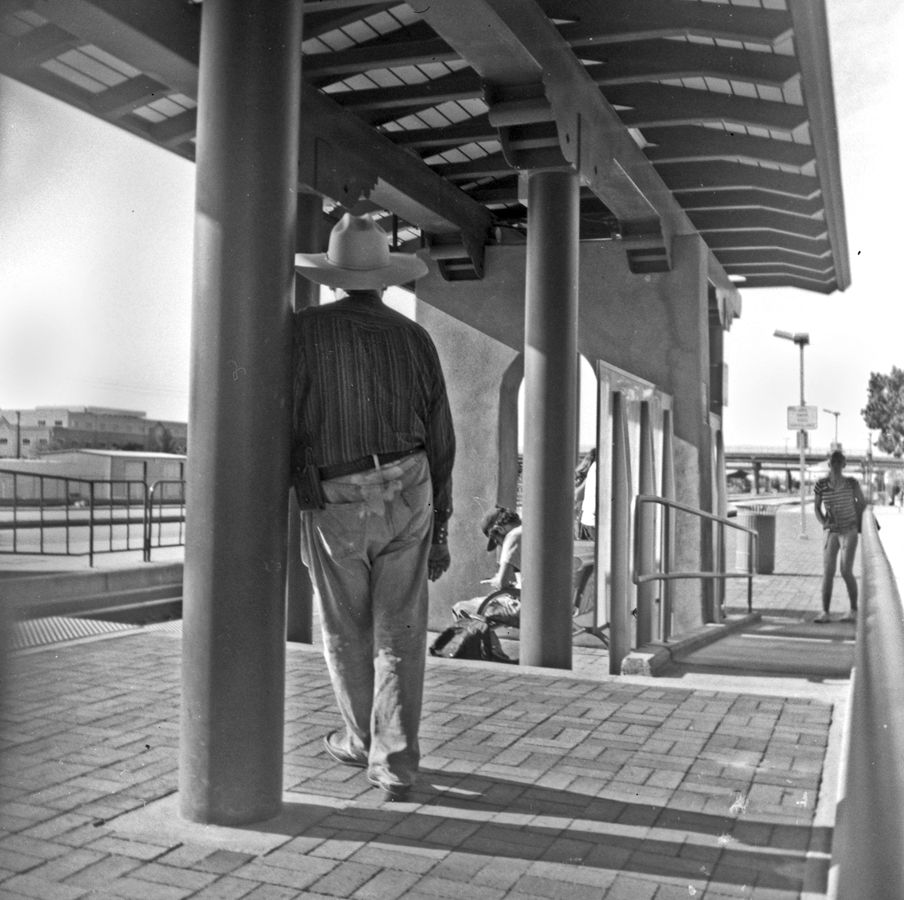
I got out the next morning to finish off the twelve frames at the Albuquerque RailRunner station.

Albuquerque Station

Arrival

Southbound

The close-up lens and the yellow filter definitely extend the practical capabilities of the Anscoflex II.  The ratcheting film advance is novel, but clunky and slow in operation.  The large and brilliant viewfinder screen puts the camera into a class of its own, unrivaled in the world of film cameras.

Like all the brilliant-finder cameras beginning with the Voigtlander Brilliant, the Anscoflex II has a massive biconvex magnifying lens under the viewscreen.  In addition to that, however, this camera also has a very large-aperture front-facing viewfinder lens which further illuminates the on-screen image.

While most of the modern-day popularity of the Anscoflex II is likely due to the capacity for making through-the-viewfinder (ttv) digital images, the superb view also greatly enhances the task of composition prior to committing the image to film.

I enjoyed my recent outing with the Ancoflex II and I'll likely take another spin with it some time soon.

Wednesday, October 24, 2012

Anscoflex II

Ansco introduced its new Anscoflex camera with a full-page ad in the July 19, 1954 issue of Life Magazine:
"...Styled by Raymond Loewy, this completely new reflex camera combines smart good looks with modern technical advances and sturdy metal-clad construction to bring you everything you've ever wanted in an easy-to-use snapshot camera!..."
Raymond Lowey, the renowned industrial designer, probably did have something to do with some of the design aspects of the Anscoflex, but most of the camera's features were already present in a 1948 Ansco prototype camera called the Shurflex. Ad hype aside, there was a lot that was new and interesting in the design of the Anscoflex. The modular construction of the all-aluminum case was a sharp contrast to the molded plastic cases featured in most of the inexpensive snapshot cameras of the era. When most of Ansco's competition had persisted in using singe-element meniscus lenses in their inexpensive cameras, the Anscoflex featured a two-element symetrical lens design with an additional close-up lens that could be swung into position with the turn of a dial on the camera's front.

Some of the new Anscoflex features, however, offered more novelty than usefulness. The tripod socket was unaccompanied by a cable release socket, and the side-mounted shutter plunger was stiff and likely to lead to blurred shots. While the ad copy likens the ratcheting film advance to winding a watch, it was really more like winding a grandfather clock, with about fifty quarter-turn rotations required to get the film to the first frame on the 620 roll. The built-in yellow filter was something of an anachronism at a time when photography was moving quickly toward the universal use of color.

The most distinctive feature of the camera, the sliding front cover connected to the flip-up barndoors over the viewfinder was something of a gimmick too, though a useful one. What was really important, though, was the extremely large and brilliant view provided by the reflex viewing system with its mirror and massive lenses. Even in the dimmest scenes where the flash would be a necessity to obtain an exposure, the view through the big top window was crystal clear. That brilliant viewfinder was also the feature of the Anscoflex which would lead to a sort of rebirth of the camera a half century after its introduction.

If you visit the Flickr photo sharing site and do a search on the term, Anscoflex, you will turn up thousands of recently made pictures tagged "Anscoflex". However, probably not one in a hundred of the photos were made with film in the camera. Instead, the great majority are the result of pointing a digital camera at the brilliant view screen of the Anscoflex to directly capture the image using the through-the-viewfinder (ttv) technique.

For those willing to re-roll some 120 film onto 620 spools it is still possible to do real photography with the Anscoflex. It won't be a process that is quick, easy or very predictable, but some distinctive images and some satisfaction are guaranteed.

Some examples from the Anscoflex II:


Should your Anscoflex need some cleaning there is an excellent detailed tutorial by Shane Blomberg at Flickr. The manuals for the Anscoflex and the Anscoflex II are at the Butkus site.

Friday, August 24, 2012

Anscoflex II Origins


Quite a bit of the history of Ansco can be found at Bill's Photo History site, including a well-detailed chronology of the company and a full page of Ansco protoype pictures.  The picture below shows some color treatments which Ansco considered for the Anscoflex II before settling on the basic gray of the the production model.