Saturday, March 27, 2021

Like New

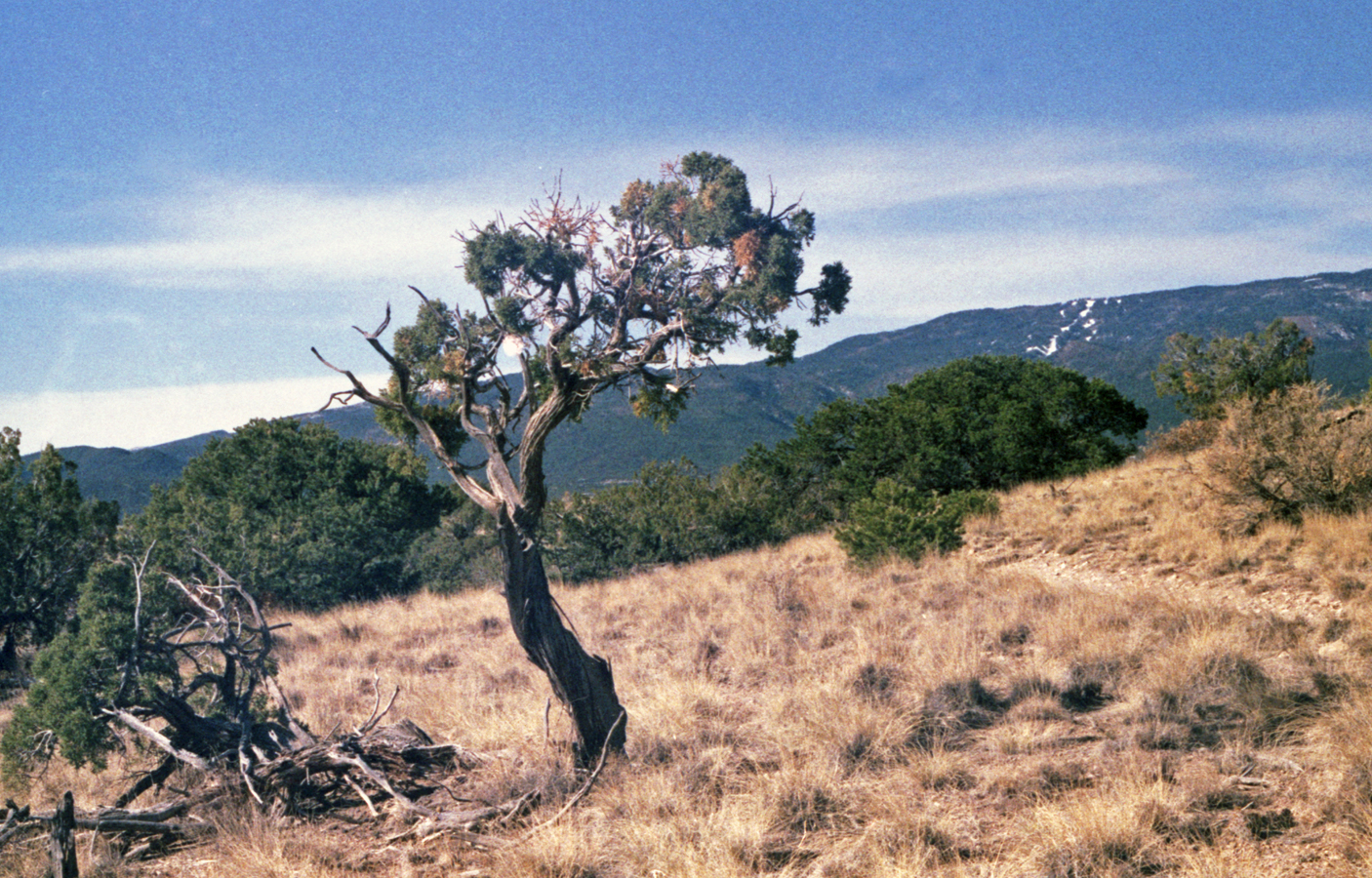
I decided to try some of the expired color film I recently acquired.  I am not usually optimistic about the chances of getting predictable results from old color film, but this Fuji 400 was only a few years past its expiration date and it had been in frozen storage.  I loaded the roll into my Spotmatic SP, made a few shots on a walk in the Sandia Mountains, and then finished up with a morning stroll around our neighborhood.


I processed the film in Cinestill C-41 for six minutes at 95C and can't see any issues with the pictures attributable to the film's age.  I have one more roll of the Fuji, and several of Kodak Gold which is considerably older, but it has also been properly stored.


No film test of course is complete without a picture of the cat.

Sunday, March 21, 2021

Old Film, Old Camera

 Among the trove of expired film I was recently gifted were six rolls of 120 Tri-X Professional with an ISO of 320.  I decided to shoot the first roll with a use-by date of 08/1992 in my Welta Perle folder.  I made a few shots in my neighborhood and then spent a morning walking around the UNM campus.

I gave the film an extra stop of exposure to compensate for age and then processed it in L110-b for six minutes at 20C.  The negative density was a little thin, but there were no obvious age-related artifacts in the images.  I'll try an additional stop of exposure in the next roll, and maybe add another minute in the developer as well.


UNM Alumni Memorial Chapel - Architect: John Gaw Meem


The Welta Perle is the oldest of my 6x4.5 folders, but also the best preserved, it looks like it was hardly used since it was produced in 1935.  The f3.5/75mm lens is a Carl Zeiss Jena Tessar which is uncoated, but still a sharp performer as long as it is not brought too close to the sun.  The rugged old Compur shutter seems accurate throughout its range.

Many of the 6x4.5 cameras have light leak problems because of the need for two ruby windows in the back.  The Welta Perle is totally light-proofed with a swiveling cover for the windows and tubular baffles over the film holders.

Thursday, March 11, 2021

Ilford Pan F 50

Thanks to my friend, Kodachromeguy, I have a big pile of expired film to play with.  First up is a roll of Ilford Pan F 50.  The expiration date on this one is June 1991.  I loaded the first roll into my Argoflex Forty and went to the Botanical Garden to shoot some familiar scenes.   I gave the film a couple extra stops of exposure to compensate for age and processed in Rodinal 1:50 for 11 minutes at 20 deg. C.

The first shot of the brick path through the garden seemed perfect in regard to exposure and tonalities, but I either misfocused, or the speed was a bit too slow.  The next shot of the fountain was better in regard to sharpness.  Bracing the camera on the ground probably helped to keep it steady.


In the middle of the roll there were a couple very dense, strange looking frames.  Hard to say what happened there.


Toward the end of the roll the images seemed normal in every respect.


Here is what I really, really like about this film:

the backing paper.


The numerals and lead-up symbols are marvelously visible through the ruby window which is used for advancing the film in a lot of old medium format film cameras.  By contrast, the framing marks on modern films are so dim and low contrast that it is nearly impossible to properly advance the film without overlapping frames or missing frames altogether. 

I have a couple more rolls of Pan F and am looking forward to shooting them, perhaps in different cameras which offer a bit more control over exposure and focusing.

Tuesday, March 02, 2021

The Spiralite Proxivar

I don't recall when, where or why I acquired this Spiralite Custom Proxivar.  I'm sure the accessory close-up lens did not fit on anything I had at the time.  I came across it in a box recently and realized the Proxivar would screw onto my Nikkor lenses.


The instruction sheet in the box provides a good description of the capabilities:

The SPIRALITE CUSTOM PROXIVAR is a most remarkable auxiliary close-up lens which provides a continuous focusing range from about 30" to under 4" simply by rotation of its calibrated focusing mount.

The Custom Proxivar performs the function of the entire series of close-up lenses ranging from +2 diopters to +8 diopters while still maintaining any existing auto diaphragm feture and without affecting exposure.

I had half a roll of Kentmere 400 left in my Nikon F, so I screwed the Proxivar onto the Nikkor 1.8/50mm and shot some pictures around the house.


The Proxivar's magnification adjustment is very smooth and the pictures it makes show no diminution in the quality which is expected of the Nikkors.  At small apertures there is a tiny bit of vignetting apparent in the corners.  For close-ups with maximum depth of focus a tripod is essential, but it is feasible and fun to explore the selective focus capability provided by the Proxivar with the camera hand-held.

The Spiralite Custom Proxivar was a typical offering of Spiratone, the importer and distributor of camera accessories and lenses whose ads were featured in camera magazines for the half-century up to 1990.  The company's founder, Fred Spira, started his company by processing film in his bathroom and built up from there into a multi-million dollar operation based largely on his early realization of the potential of the Japanese photographic industry for building low-cost, high quality photo gear.

Spira was also a collector of photographic gear.  His vast assemblage of over 20,000 items became the basis for his book, The History of Photography As Seen Through The Spira Collection. I was pleased to find used examples of the book online and am looking forward to reading it.
Tuesday, February 23, 2021

Exercising the Olympus 35RC

I spent the week carrying around my Olympus 35RC.  It is a camera I have had for a long time, but I haven't often put film in it.  I think I bought this one in Las Cruces about fifteen years ago for around $40.  I subsequently found a couple others in thrift stores.  

The 35RC was built for Mercury batteries, but the meter is easily adjusted to use available 1.5 volts ones.  The five-element 2.8/42mm lens is sharp and contrasty. 


Andrew Yue has a nice review of the 35RC's features and operation.
Click here to see all my posts and pictures about the Olympus 35RC.

Sunday, February 07, 2021

Nikon FG-20

 The Nikon FG-20, dating from 1984, is compact and light-weight like the Nikon EM which preceded it.  While the FG-20 shares many features with the EM it has a full range of manually selectable shutter speeds in addition to an auto-mode for the electronic shutter.  Like the EM, the relatively inexpensive FG-20 will allow use of most of the great bayonet-mount lenses made for the earlier F-Series cameras.


The Nikon FG-20 does not offer the smooth precision in operation of the earlier pro-line F cameras, but it is rugged and reliable.  The previous owner of this example bought the camera used in the 1980s and shot it well into the '90s.  It then sat in in a camera bag unused for about twenty years.  When I got the camera, I removed the two long-dead batteries, installed new ones and the camera came to life and seems to be operating nearly like new.


The Nikon FG-20 came to me in its original big camera bag along with a full set of accessories including documentation, filters, electronic flash and a motor winder.  There was also a 2.8/28mm Zykor MC Auto lens and a Vivitar Series 1, 3.5/70-210mm Macro Focusing Zoom which focuses down to four feet.  There is some fungus creeping in from the periphery of the Zoom's front lens; it doesn't look like that is affecting image quality at present, but it would be nice to get it removed before it gets any further.  The motor winder had some ancient corroded batteries left inside and is not currently functional.  I likely won't get around to using the flash or the winder, even if I can get them working.

Monday, January 25, 2021

Shooting the Beast

 I nearly always like the images I get from the Mamiya C330 and each time I shoot it I pledge that I will use it more often.  It doesn't happen.  I average picking up the camera once yearly.  That's been going on now for ten years.  

I loaded some HP5+ into the C330 on Saturday and went down to the river in the afternoon.  There were ducks, geese and cranes in the ankle-deep water from bank to bank.  It was a scene that seemed to call out for some telephoto work.  Of course, I had left the 180mm lens for the C330 at home along with all the other accessories for the camera.  Luckily, the 2.8/80mm lens is ultra-sharp and the HP5+ combined with PMK Pyro processing yields very fine grain.  So, I came home with one good bird shot.

I think the lens on my YashicaMat is likely just as sharp as the lenses I have for the C330.  However, the close focusing and parallax correction available in the Mamiya give it the edge whenever I'm out prospecting for images.

On my recent outing with the camera I used the waist-level finder; it is very bright and easy to focus with the flip-up magnifying lens.  The Porroflex finder is a little dimmer and does not completely show the full image that will be on the film, but it makes shooting at a downward angle much easier.  The accessory grip  in combination with the neck strap also contributes greatly to managing the heavy camera.

Saturday, January 23, 2021

Tweaking the Leotax & the Jupiter 12

 I took a walk in the neighborhood with the Leotax after making some adjustments.  


I decided to slightly lessen the tension on the first curtain in order to reduce the shutter capping which was giving me an uneven exposure across the frame.  The Leotax makes such adjustments a bit easier than the Leica.  You just lift the spring off the cogwheel and turn it slightly clockwise and then let the spring down again to maintain the setting.

I also applied some black paint to the rim of the Jupiter 12's rear element to eliminate some flare at the edge of the images.  

Both adjustments seem to have worked.  The exposure across the frame seemed even, and the odd flare I got in images from the Jupiter 12 lens was gone.  The film I used for the test was some Agfa APX 100, expired 07/98.  I gave the film a couple extra stops of exposure to compensate for age, but it still required a bit more of a boost with Photoshop to get the proper tonal values.  The APX was processed in Rodinal 1:50.


The Leotax really needs a full CLA, but I'll likely let someone else undertake that assignment.  I was pleased with the progress on the camera, and even more so with the improved performance of the Jupiter 12 lens, which is a favorite for use with the Barnack-style cameras.