Showing posts with label Tri-X pan 320. Show all posts

Tuesday, May 18, 2021

Mesilla

We spent a few days visiting with friends and family in Las Cruces.  Our motel was close to the little town of Mesilla, so it just took a couple minutes to drive there on a Friday morning to visit the plaza and shoot a roll of film in my Brownie Hawkeye Flash.

The town clings tenaciously to its past; things change, but more slowly than in most places.  The economy is still closely attached to the land, and traveling south or west quickly brings visitors to fields of onions and vast pecan orchards irrigated only with ground water.  The Rio Grande is mostly dry long before it gets to Mesilla; the acequias that run through town contain only sand.

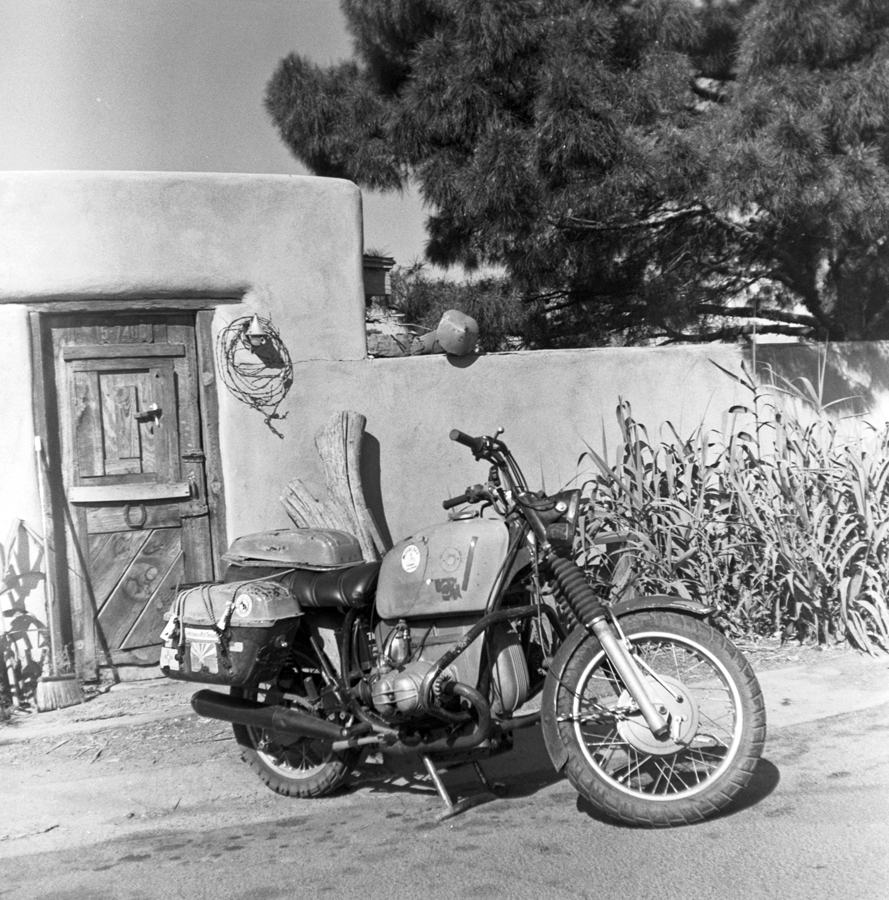


The Kodak Tri-X Pan Professional film I shot in Mesilla was rated at ISO 320; that would be a bit fast for a sunny day in the Brownie Hawkeye Flash, but it seemed like the twenty-seven years beyond the expiration date would likely have tempered the sensitivity of the film sufficiently to allow use in the old box camera.  I processed the film as recommended in the data sheet in the film box and I thought the results were pretty good.

Sunday, March 21, 2021

Old Film, Old Camera

 Among the trove of expired film I was recently gifted were six rolls of 120 Tri-X Professional with an ISO of 320.  I decided to shoot the first roll with a use-by date of 08/1992 in my Welta Perle folder.  I made a few shots in my neighborhood and then spent a morning walking around the UNM campus.

I gave the film an extra stop of exposure to compensate for age and then processed it in L110-b for six minutes at 20C.  The negative density was a little thin, but there were no obvious age-related artifacts in the images.  I'll try an additional stop of exposure in the next roll, and maybe add another minute in the developer as well.


UNM Alumni Memorial Chapel - Architect: John Gaw Meem


The Welta Perle is the oldest of my 6x4.5 folders, but also the best preserved, it looks like it was hardly used since it was produced in 1935.  The f3.5/75mm lens is a Carl Zeiss Jena Tessar which is uncoated, but still a sharp performer as long as it is not brought too close to the sun.  The rugged old Compur shutter seems accurate throughout its range.

Many of the 6x4.5 cameras have light leak problems because of the need for two ruby windows in the back.  The Welta Perle is totally light-proofed with a swiveling cover for the windows and tubular baffles over the film holders.