Monday, March 30, 2009

Backyard Drama Queen


Friday, March 27, 2009

Old Town Albuquerque


Albuquerque has a pretty tenuous grasp on Spring right now. Still, this Mariachi group made an appearance at several places around the Old Town Plaza to try to warm up the tourist trade, and they seemed to be having some success.

Thursday, March 26, 2009

Clash of the Classics


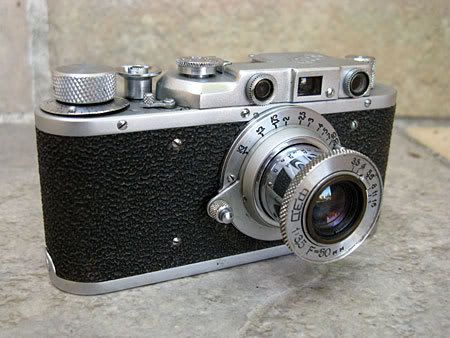
FED 1g


Kiev IIa


I thought I would try out a new blog feature, a poll. The subject as seen at top right is people's choices today in one of the great marketing competitions from the past. Zeiss Ikon and Leitz fought toe to toe for three decades for the allegiance of luxury camera buyers. The Soviet Union mirrored the competition with it's production of FED, Zorki and Kiev cameras for about the same length of time.

I'm pretty sure that a lot more Leicas, FEDs and Zorkis were sold than Contax or Kiev rangefinders, but that doesn't really address the issue of quality or the particular features which attracted users. My own preference will be obvious from the amount of work I've done with the two camera lines. I've put quite a few rolls of film through my FED 1g since acquiring it just a short time ago. Although I was originally very taken with the Kiev IIa, I have really done very little with it since acquiring it five years ago.

The big thing for me is pocketable design, and there is really no contest there -- you don't want to try jamming the Contax or Kiev cameras in your pocket. Beyond that, the Barnack Leica has, in my opinion, never been bested for its combination of elegance and usability.

That said, Contax II and III and their Soviet counterparts were nice to look at and hold, and there were some features that were definitely better than what the Barnack Leicas could offer. The bayonet quick change lenses were obviously an attractive feature for photojournalists and others needing quick response. The wide-base rangefinder of the Contax design is probably superior to the Leica, and the metal shutter curtain and general build of the Contax/Kiev cameras was extremely sturdy.

Cartier-Bresson gave a big push to Leica sales, but some other very fine classic photographers chose Contax -- I'm thinking for instance of Russell Lee and Robert Capa. It might be interesting to come up with a list of who used what among the greats.

The lenses on both cameras were amazingly good in their time, and it seems somewhat pointless to attempt a critical comparison. While the Soviet examples tended to have poorer materials and workmanship, the image quality is often as good or better than the original German designs -- I'm thinking particularly of the coated Soviet Elmar-type collapsible lenses that came on the later Zorki and FED cameras.

Tuesday, March 10, 2009

I spent some time this evening going through the blog. There have been almost 200 posts over nearly three years. Time for a break.

PS: With some freed-up time I'm working on some enhancements and additions to my web site. The photo or graphic on the index page will point to whatever I'm up to at the moment.

Monday, March 09, 2009

Sunday morning at UNM


This is the first color I have shot in one of my Brownie Hawkeye Flash box cameras, and maybe only the second roll of color in any of my medium-format cameras. Cost is always a concern, but finding a lab to do a decent job on the processing is an even bigger challenge. I got some free film recently which took care of part of the cost issue, and the processing was done at Picture Perfect in Albuquerque which does the work all by hand. I'm favorably impressed by the results, though I wish they weren't located clear across town.

Saturday, March 07, 2009

Yerba Mansa
(Anemopsis californica)


One of my goals for this Spring is to cultivate some wildflowers. I've ordered some seeds and some plants, and this morning I brought home a dozen Yerba Mansa seed capsules from a walk by the river. Each of them seems to have a couple hundred tiny seeds, so I'm hoping a few will sprout, though I believe they are somewhat difficult to grow from seed.

I first encountered Yerba Mansa in a little bog between the road and the Rio Grande about twenty miles north of Las Cruces. The photo of the flower was made on June 9, 2002 using a little 1.3 megapixel OLYMPUS D360-L. A lot of water has flowed down the river since then.

Friday, March 06, 2009

just practicing


I can't claim to have mastered my plate cameras, but I am feeling more comfortable with them. I think we are due for about a week of cool and cloudy weather. When that is by, I'll try to get out with the Maximar and the Recomar to attempt a broader range of subjects.

Wednesday, March 04, 2009

For Our New York Friends


Tuesday, March 03, 2009

Two compacts


I like cameras that can fit easily in a jacket pocket. I've added pages to my web site for two I like very much.

The Retina I is a 35mm folder that I've had for some time; I'm especially fond of it not only because of the nice images it makes, but also because I worked especially hard to get it working like new.

The Zeiss Ikon Maximar A is a compact plate camera from the early part of the last Century. Acquired just a few days ago, the Maximar has an extraordinarly fine Tessar lens, and only required a couple hours to get it operational.

Sunday, March 01, 2009

Another camera?


Yes. I just couldn't pass up a Zeiss Maximar-A plate camera with a Tessar lens for ten bucks.

Wednesday, February 25, 2009

swan rider


I've put another roll of film through my Kodak Recomar 18 and posted the images on my web site.

Saturday, February 21, 2009

a good sign


All the leaves but one fell off this kumquat. Lately, it has begun to come back. With 70-degree temperatures predicted for later in the week, we should see some flowers in the yard soon too.

Wednesday, February 18, 2009

Sorting out old cameras.


There are always a lot of variables in producing photographs. Shooting with very old film cameras introduces a lot more. One of the major issues is differentiating results attributable to the equipment from those that are a product of user technique. To help myself in evaluating the photos I am getting from my Kodak Recomar 18, I decided it would be useful to get some comparison shots of the same subjects with a proven performer, the Pentax Spotmatic. So, I took the Pentax to the Conservatory at the Botanic Garden and got some shots of the lilies and other plants I had made pictures of a few days ago with the old Kodak. It did prove a useful exercise, and I will have more to say about it shortly.

Monday, February 16, 2009

Sunday, February 15, 2009

Pueblo Bonito, Chaco Canyon


These ancient ruins in Chaco Canyon are the finest that North America has to offer north of the Rio Grande. What makes it such a special place will be largely destroyed if the 30-mile road into it is paved as has been proposed. Developers and tour buses just are not compatible with the Chaco experience.

There is a column in today's Albuquerque Journal by Leslie Linthicum on the status of the road paving proposal, and there will be a follow-up in Thursday's paper. It seems doubtful the county bureaucrats who have advanced the proposal can succeed without a massive infusion of aid. If that looks like it is going to happen, it seems to me an appropriate response would be to close access to the National Park from the north side. People really wanting to visit the place could still get in via the south road, and the blockage would effectively undercut the motives for development.

Friday, February 13, 2009

At the Botanic Garden


I went to the Albuquerque Botanic Garden today with my Kodak Recomar 18. It is a compact folding plate camera with an extended bellows. The Recomar was built to use sheet film, plates or film packs. I have some sheet film holders I've never used for it, but I also have a Rada rollfilm adapter which lets me use 120 roll film. I normally make 6x9 cm negatives, but it is also possible to use masks in the Rada to get either 6x6 or 6x4.5 images.

The Recomar never quite performs the way I expect, but it is an interesting camera to shoot. I'm going to try sorting out some of my issues with the camera, and maybe I'll write an article about it for my vintage camera site.

Tuesday, February 10, 2009

Back to the drawing board
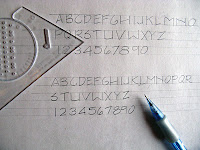


Every few years I get disgusted with the lack of style and legibility of my handwriting. This is a cycle that has been repeated for well over half a century now. You would think I might have been able to avoid this, given that my early school years were in an era in which handwriting instruction was taken seriously. My teachers demonstrated proper letter forms on the (black) blackboard, and I tried to follow along after dipping my steel-nib pen in a bottle of ink on my wooden desk. It just never took.

The last time I tried to repair my handwriting performance was during one of those periodic appearances of interest in calligraphy. It was kind of fun, but my production never showed much style. I don't expect to achieve great artistry this time around, either, but I think I have a better chance of useful self-improvement because I've chosen to focus on the simple lettering style favored by modern draftsmen and architects.

What got me started was a posting at the Design Observer blog, which led to a great little instructional video at Doug Patt's How to Architect blog. Doug brings a lot of experience and sophistication to a simple lettering style, and his brief demo is really inspiring.

I decided I should really start with something more fundamental than Doug Patt's example, so I googled around until I found JoBeth Halpin's Architectural Drafting Fundamentals at the Triton College web site. That proved to be exactly what I was looking for. The step-by-step presentation and the interactive exercises are wonderfully designed for the beginning draftsman. The next morning, I went to two art materials stores and picked up the necessary tools including a drawing board, pencils and an Ames Lettering Guide. I have to confess those nifty little plastic gizmos are a big part of the attraction for me of this type of undertaking. At this point, I've invested less than an hour in the project, but I'm encouraged by hints of progress already.

This activity has also been a nice excuse for me to look more closely at the extraordinary learning opportunities available through the web. I've generally avoided on line video up to this point, but the power of the medium is really seductive, and I feel myself moving toward it quickly.

At the same time, I'm also pleased to get back to working on some purely manual skills. Computers are great, but they can create a false sense of competency; it becomes difficult to distinguish your own real skills from what the computer is mostly doing behind the scenes. This also applies to the field of photography, and partly explains why I prefer to work with film and old, manual cameras.

Sunday, February 08, 2009

Tramway

Tramway


An out-of-town visitor provided an excuse to ride to the top of the Sandias on the world's longest aerial tram.