Showing posts with label restoration. Show all posts

Wednesday, August 05, 2026

Transformations

This image is from a broken glass plate negative made at Cobb's Studio in Albuquerque in 1916,  The Albuquerque Museum's Archivist, Jill Hartke, included it in an exhibit about the various kinds of damage which are sustained by these old glass plate negatives over the years.  In this case she carefully assembled the broken pieces and scanned the result.

As Hartke notes in a Youtube video about the damage to this image and others that were scanned for the show, the damage actually produces something new and interesting beyond what might have been present in the original negative.  I think what she may have had in mind was the Zen-inspired idea of Wabi-Sabi or Kintsugi.  

As explained in Wikipedia, 

 This traditional Japanese art is called Kintsugi (golden joinery) or kintsukuroi (golden repair). Artisans mend broken ceramic pieces using a natural tree-sap lacquer dusted or mixed with powdered gold, silver, or platinum. Rather than hiding the damage, the method highlights the cracks to treat breakage as a proud part of the object's history.

 I'm comfortable with that idea, but I was also curious about what AI tools might be available to restore damaged images to something close to how they originally appeared.

A quick search turned up ai.nero.com/photo-restore, and a few minutes work produced several levels of restoration:


I thought the free-trial AI program did a pretty good job of what it was asked to do.  Definitely not Wabi-Sabi, but I suspect there are AI tools available which could get much closer to the kind of subtle refinements consistent with the ancient tradition.  

Monday, September 26, 2022

Celebrating SF 2926

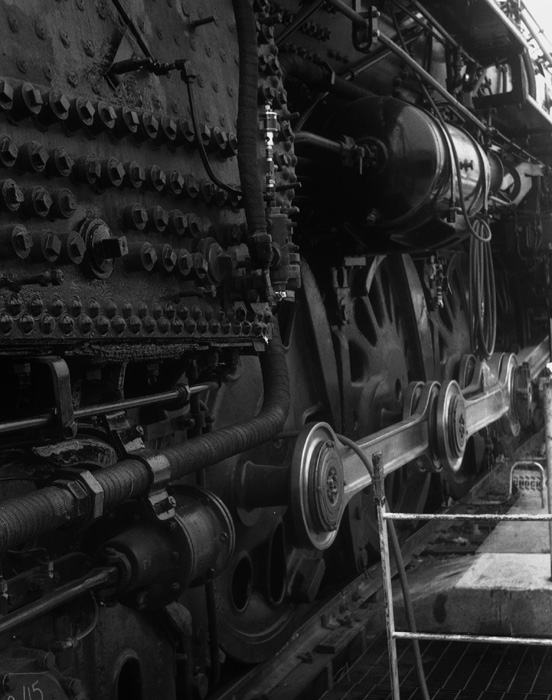
The SF 2926 locomotive has been on a siding about a mile from our home under restoration for the fourteen years that we have lived in Albuquerque.  I have visited the site many times, but on this Saturday there was a special open house to mark the completion of the project.  All that is left to do now is to get through the bureaucratic processes to get onto the tracks.

There was free food and free drinks for the whole crowd that showed up, along with a brass band and a jazz group for entertainment, and plenty of memorabilia for sale including posters, books and t-shirts.


The SF 2926 sat rusting in a city park for many years, but now it looks much as it did when it was carrying freight all over the country.


Monday, June 04, 2018

Inside the Samoca-35 Super

The little mid-'50s Samoca rangefinder brings a good price on ebay because of its unusual design.  However, you don't see many pictures posted from the camera, and I have never seen anything on line about restoring the Samoca until now.  A few days ago, Urs Fischer emailed me saying he had seen some of my Samoca shots on line.  He asked if I knew anything about adjusting the vertical alignment in the rangefinder as his was out of alignment.  I had to reply that I could be of no help with the problem as mine was in good working order when I got it and I had no need to look under the hood of the camera.

Undeterred, Urs proceeded to completely disassemble the camera, and he sent me the set of pictures.


Urs said he encountered no great difficulty in taking apart the Samoca, or in getting it all back together again.  Unfortunately he did not find the key to adjusting the misaligned rangefinder.  Here is what he reported back about his findings:
I took my camera completely apart, under the topcover one can clean all the glasses and mirrors, but the length adjustment is done by the cogwheel on the frontplate, the beam splitter and the deflector mirror are glued to the rangefinder housing without any possibility of adjustment. The distance measurement is done by a moving lens. That's why I thought of the rangefinder window cover has a adjustment optic and because it is knurled, and because mine is missing.

So anyway, perhaps time will tell,
meanwhile I wait to see the first pictures,
thanks and regards
urs fischer
So, still another chapter to go in the Samoca restoration, but the information Urs contributed is a big step forward for those of us with an interest in the unique little Samoca-35 Super.

UPDATE (June 3, 2022)

The mystery of rangefinder adjustment appears to have been solved!  I received an email from Christian Treiber with the following explanation: 

There is a screw hidden in the axis of the upper Knob that will show the distance.  When you take up the leather, you will see the Nut, and deep in the nut is a screw where you can adjust the Split sreen or picture .  There you can synchronize the infinity of the lens and the split window.

* * *
Since it has been a long time since I last made any pictures with the Samoca, I loaded a roll of Kodak ColorPlus 200 and shot all 36 exposures over the weekend in the Plaza Vieja.


I had to make some substantial contrast adjustment to the pictures from the Samoca.  I suspect that was no fault of the camera, but rather a function of my C-41 processing.  I'll try some Fuji next time around to see if I can sort out the processing issues.

Sunday, May 27, 2018

2926

I've been watching the restoration of the 2926 locomotive for the ten years we've been in Albuquerque.  It looks like all the parts are back together.


On the day of my visit the task being worked on was making the whole thing water-tight.  That is quite a challenge as there are hundreds of old brass fittings that must withstand very high pressures.


The camera was my Fed-1g with the Fed 3.5/50 lens.

Monday, February 06, 2017

Dawn Camera

The H3v, known outside the U.S. as the SV, was the immediate precursor to the Pentax Spotmatic. It had all the basic features of that ground-breaking camera with the exception of a built-in, through-the-lens meter.


This one came to me with the very fine Super Takumar 1:1.4/50 lens.  Unfortunately, the camera also arrived with a shutter that intermittently would not fire.

I played with the camera's settings to try to understand the shutter problem and found that the shutter worked better with the aperture auto-stopdown feature turned off, and it seemed to work faultlessly with no lens mounted.  So, time to search the web for possible explanations.

After quite a bit of digging, I came across the likely answer at the Pentaxforums.com web site to the apparent shutter problem, which in reality was a compatibility issue.

"The SV came in an early and a late type. The latter has an orange 'R' on the rewind knob which tells that the camera can use the 50mm f/1.4 lens (which protudes farther into the camera than all other 50mm lenses)"


So, that green R designating the rewind knob is clearly pointing to the source of the difficulty.  That does not explain exactly, however, how the misfit lens was interfering with the action of the shutter.  My first idea was that the little flapper that activates the aperture stopdown was implicated in the problem.  On further thought, and considering the clicking sound of the misfiring shutter and the likely train of events in the process, I decided that it was likely the instant-return mirror hitting the lens that was stopping the normal shutter cycle.

With the lens off the camera, I brushed Ronsonol lighter fluid onto the mirror levers that were visible in the interior of the camera body.  Then, I mounted the slightly slower, but still very good 1:1.8/55 Super-Takumar from my old Spotmatic.  I worked my way through the full range of shutter settings many times without encountering any hesitation in the shutter's action.  The final test, of course, was to shoot a roll of film in the H3v.  I dropped in a roll of Kentmere 100 and took the camera on my usual walking route through Albuquerque's Old Town.  I only got a couple images I haven't shown here before, but I'm very happy to report that I came home with twenty-four perfectly exposed images.


The H3v story for me provides some interesting insights in several regards.  I think it points to the fact that Pentax and the Japanese camera industry at the time of the introduction of the H3v was undergoing a pace of discovery and technological development of a vertiginous nature.  The complexities were such that some compatibility issues were inevitable.  It also shows that Pentax and other Japanese companies were up to the challenge, and explains much of their long-time international dominance of the industry.

My own encounter with the H3v also provides some insight into my approach to camera restoration.  My tendency is to look for the simplest, non-destructive solutions to common problems encountered with the old cameras.  My objective is to get the equipment working well enough to make pictures reasonably close to what might have been expected when the cameras were near new.  I know that is a stance that will rankle with people who have more of an inclination toward mechanical expertise, but I'll happily admit that I'm a photographer first, and a camera repairman only as a last resort.  Of course, this approach only works in the short term.  If I need a camera to be ready to perform on a regular basis I think a better option is to seek the help of someone who has real skills.