Friday, October 31, 2008

Halloween


Margaret found this fellow dining on a grasshopper in our backyard just before nightfall.

Wednesday, October 29, 2008

Joy


I fixed a sticky aperture on my Contaflex I. The camera was an early single lens reflex model built after the War by Zeiss. It is about the only one of its type that will fit in a pocket, and it sports the magnificent coated Tessar lens. I'm happy.

Tuesday, October 28, 2008

Faux Leica


I've been carrying around my FED 1g again now that the shutter is fixed. With the collapsible lens it fits comfortably in a pocket. The Elmar-copy Fed lens is fantastically sharp, though it tends to flare near the sun.

Saturday, October 25, 2008

Sitting


Unless you live in a tent and move with the seasons, you will likely find yourself as part of travel preparations more or less formally arranging for the care of your possessions and pets.


We found ourselves recently explaining the surprising complexity of caring for our cats - three insiders and three outsiders. Our pet sitter was also instructed to bring in the mail and water the plants. Then, of course, we forgot to describe the quirks of the cats in sufficient detail, so we composed a note with the additional details to be left on the table before we departed for Seattle.


We ourselves are presently pet sitting for our daughter, and make two trips each day to feed their two dogs and the old cat, a task that requires a rather intricate choreography.


Simultaneously, we are car sitting for our neighbor who has flown off to South America.

Life in the city is complicated.

Friday, October 24, 2008

Autumn's Beginning


A couple frosty mornings have just touched the cottonwood bosque beside the Rio Grande. During my walk today I heard the calls of cranes passing overhead. A pair of Coopers Hawks darted through the canopy, and a Sharpshin spoke to me in a strange, small voice.

Zeiss Ikon Contaflex I

Sunday, October 19, 2008

The Belly of the Beast


We walked over to the AT&SF 2926 Open House on Saturday morning. There has been a lot of progress on the locomotive's restoration, and the mood of the volunteers was very up-beat. I posted some more photos from the day in a thread at photo.net.

Pentax Spotmatic with 24mm SMC Takumar

Thursday, October 09, 2008

Totem


We had a lunch of fry bread and pozole in the courtyard of the Maxwell Museum where this totem pole from the Pacific Northwest is located.

Vivitar Ultra Wide & Slim

Wednesday, October 08, 2008

Pinhole Images


Making images with a pinhole camera is a good way to renew the mind's eye. Because of its imprecision the process sharpens awareness of subtleties in perspective and tonality and engages the imagination. Constraints of exposure and composition which are limiting factors in other forms of photography seem to recede, and nearly every image made through the pinhole has a compelling interest.

The photos were made at the Albuquerque Botanical Gardens.

Friday, October 03, 2008


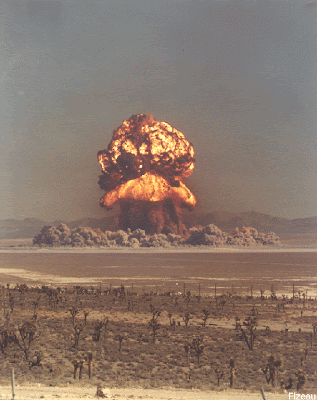
In the 1980s I ran a computer bulletin board system (bbs) that was part of a network called Fidonet, a precursor to the World Wide Web. The inventor of Fidonet was a unique personality, Tom Jennings. Trolling around the net early this morning, I stumbled on his web site and this collection of images of nuclear tests which he harvested from a publicly-accessible computer at Los Alamos shortly before it was disappeared. The complete collection can be viewed along with Tom's notes on a page at his site.


Nuclear-Weapon States and Weapons:

United States: 5,914 strategic warheads, approximately 1,000 operational tactical weapons, and approximately 3,000 reserve strategic and tactical warheads.
Russia: 4,237 strategic warheads, approximately 2,000-3,000 operational tactical warheads, and approximately 8,000-10,000 stockpiled strategic and tactical warheads.
France: Approximately 350 strategic warheads.
China: 100-200 warheads.
United Kingdom: Less than 160 deployed strategic warheads.
India: Up to 100 nuclear warheads.
Israel: Between 75 to 200 nuclear warheads.
Pakistan: Up to 60 nuclear warheads.

Wednesday, October 01, 2008

Recycling

Saturday, September 27, 2008

Neighborhood Parade


Shot with the $10 Vivitar Ultra Wide & Slim

Thursday, September 25, 2008

Two cats and a close relative


Pentax Spotmatic

Tuesday, September 23, 2008


The National Atomic Museum in Albuquerque is getting ready to move to a new location away from its current facility in the Old Town District. The expanded facility will allow the display of several WWII-era aircraft as well as other new features. The exhibits in place now are pretty well mounted and tell their story well, with the exception of the parts dealing with the dropping of the bombs on Hiroshima and Nagasaki. The story is ok as far as it goes, focusing on the point of view of most Americans at the time about the rationale of the bombing and its outcome. Where it comes up short is in depicting anything near to what the reality was on the ground in Japan. There are a few statistics on deaths, a photo of an incinerated tricycle, and another of a bunch of smiling Japanese children in a memorial park. It is an inadequate portrayal of what happened.

I took the picture of the sign on the museum roof with a '1950s Soviet camera, a FED 1g that is a copy of the 1930s German Leica. I still need to do a little work on the shutter, but the camera and the Elmar-copy collapsible lens show great promise. As usual, the cats were happy to serve as test shot models and to help me finish off the roll.


Friday, September 19, 2008

El Malpaís and El Morro


The Writing on the Wall

A brief road trip down what-used-to-be Route 66 took us to two adjacent National Monument sites south of Grants, New Mexico -- El Malpaís and El Morro.

On the east side of El Malpaís I clambered up over the boulders for a close-up view of the giant rock arch known as La Ventana.

The visit to the spectacular El Morro site and its Inscription Wall provided some new rock art pictures and got me thinking about the question of why people write on walls. That is something that will be endlessly debated because it concerns what happens inside peoples' heads. What one can easily see at El Morro, however, is how culture shapes expression in the form of rock art, and later graffiti. Over the past few centuries European-inspired messages inscribed in the El Morro sandstone all had one basic message: "I was here". The earliest European visitors, the Spanish conquistadors, elaborated on that by adding "...for God and the Empire". There was some of that in the messages left by the early American explorers and settlers too, but later messages would be merely personal and individualistic. In the earlier rock art left by the indigenous peoples, there is no apparent "I", but only an implied "We" and a reference to the relationship of the people to the earth and the gods of the earth.

It is also interesting to note the changes in the rock art over time of both the indigenous people and the invading Europeans. Themes and techniques of the native people changed very slowly and showed great sophistication in execution. Up to about one hundred years ago, the messages left by European visitors were also characterized by considerable artistry and attention to craftsmanship. The earliest Spanish inscriptions at El Morro are done in a very refined calligraphic style. The brief messages left by Americans around the time of the Civil War show an awareness of typographic styles from that time and are executed with great care. Later visitors, starting around the beginning of the 20th Center leaving the "I was here" message clearly were barely literate, and that trend continues into the present time at such remote sites.